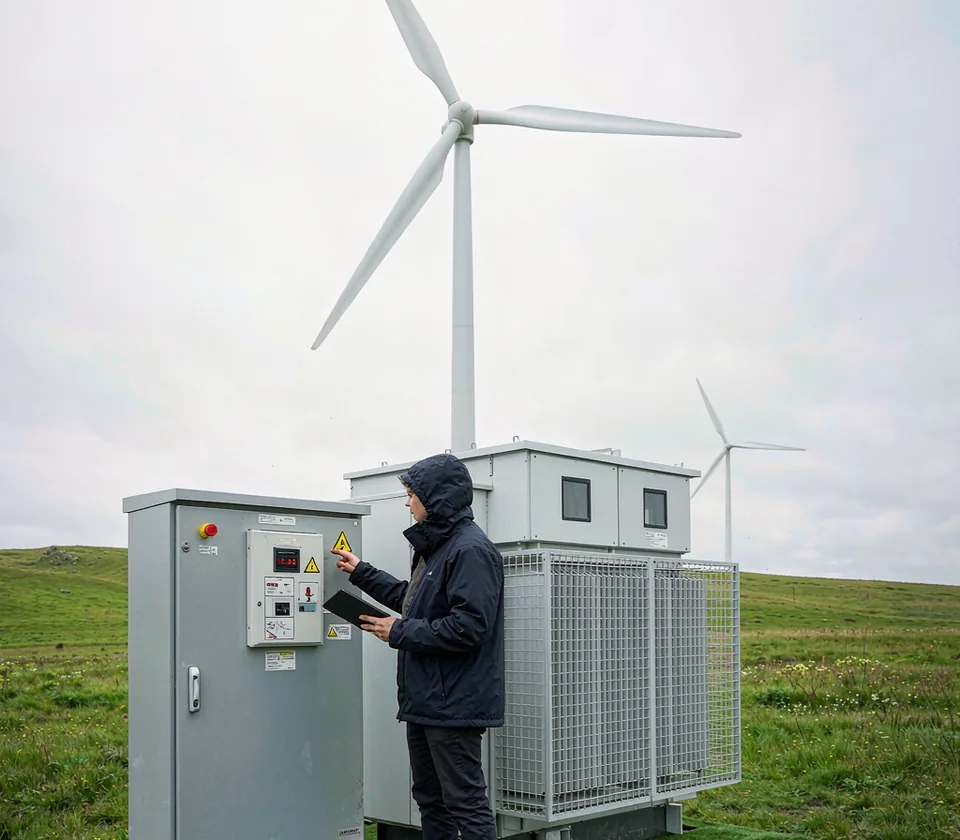
Project Overview
The financing consortium also imposed a condition increasingly common on new renewable projects: no SF6 anywhere on the collector network. Funator was engaged for the complete MV scope — pad-mounted RMUs, main substation switchgear and protection — under that constraint.
The Challenge
Steppe conditions plus lender conditions:
- SF6-free mandate: every collector-network switching device had to avoid SF6 insulation, without sacrificing 31.5 kA short-circuit withstand at altitude.
- -30 °C cold-start duty: mechanisms, lubricants and battery systems all had to function after a week of deep frost.
- 40 km collector footprint: fault location and SCADA visibility across buried rings, with no permanent on-site staff.
The Solution
SM AirSeT SF6-free ring main units were selected for the turbine pads — pure air insulation with the same footprint and ratings as the SF6 units they replaced. The main substation took MVnex 36kV with Sepam protection, and the whole network was tied into a single IEC 61850 SCADA picture with fault-passage indicators on every pad.
| Equipment | Qty / Configuration | Key Ratings |
|---|---|---|
| SM AirSeT pad-mount RMUs | 38 × units | 24 kV · 630 A · SF6-free (pure air) |
| MVnex 36kV switchgear | 12 × panels | 2500 A · 31.5 kA/3s · altitude-derated |
| Sepam protection relays | Full collector set | Directional OC · earth fault · FPI logic |
| SCADA integration | IEC 61850 | Fault location · pad telemetry · cold-climate HMI |
Execution & Delivery
- Months 1–2: collector design freeze, including altitude and temperature derating calculations for the consortium's engineer.
- Months 3–5: factory assembly; FAT at -25 °C cold-chamber verification for mechanism operation, witnessed by the owner's engineer.
- Months 6–8: summer installation window — pads installed as turbines were erected, rings terminated progressively.
- Month 9: substation energized; collector network phased into service turbine-by-turbine before the first winter.
Results
- Collector network fully energized before the first winter — first full-capacity winter delivered without a single switchgear outage.
- 98.7% turbine availability in year 1, with SF6-free equipment meeting every performance benchmark.
- Zero unplanned site visits for electrical faults; all events diagnosed remotely via the SCADA fault-location data.
“The SF6-free requirement was non-negotiable for our lenders. Funator shipped it without drama — and the cold-chamber FAT gave everyone confidence before the first winter.” — Engineering Manager, wind farm owner
Explore the Renewable Energy solution
Configuration guidance, standards and product lineup for this industry.
Renewable Solution