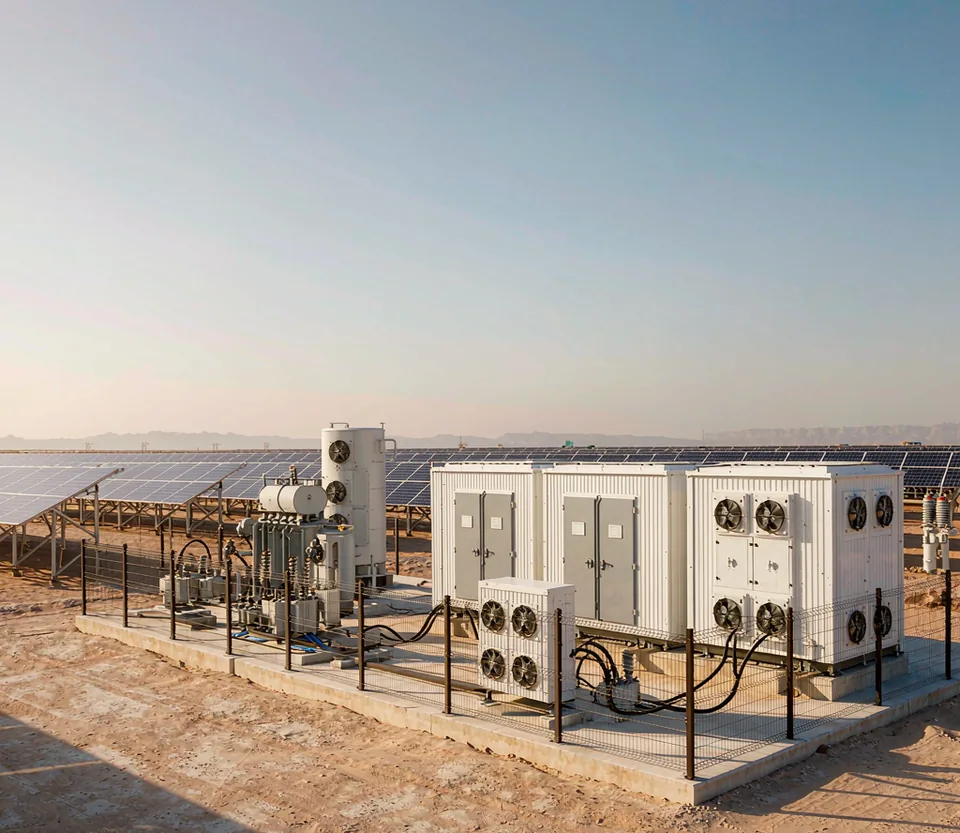
Project Overview
Funator took responsibility for the entire collection network hardware: 16 × MVnex 36kV panels, 8 inverter-skid LV packages, and the protection settings for an inverter-dominated grid — engineered for +52 °C summers and sandstorm conditions.
The Challenge
Desert PV plants punish weak engineering twice — at commissioning and for 25 years after:
- +52 °C summer ambient: standard derating curves would have left the plant short of nameplate capacity exactly when generation is most valuable.
- Sand ingress: fine desert dust penetrates ordinary IP4X ventilation and grinds down mechanisms; IP54 with sand-filtered ventilation was non-negotiable.
- Inverter-fed protection: fault currents a fraction of conventional grids make standard overcurrent settings blind — protection had to be engineered for the actual network.
The Solution
MVnex 36kV panels were specified with IP54 enclosures, sand-filter ventilation and C4 corrosion protection, with busbars derated for the site ambient. On the protection side, Sepam relays were configured with directional elements, ROCOF and vector-shift islanding detection, reverse-power logic and voltage/frequency ride-through settings matched to the grid code — parameter sheets delivered with the FAT reports.
| Equipment | Qty / Configuration | Key Ratings |
|---|---|---|
| MVnex 36kV switchgear | 16 × panels | 2500 A · 31.5 kA/3s · IP54 + sand filters |
| Inverter-skid LV packages | 8 × packages | Blokset Form 4b · skid-integrated |
| Protection relays | Sepam/MiCOM | Grid-code settings · FAT-verified |
| Collector interface | RMU feeder sets | Pad-mount · SCADA/IEC 61850 |
Execution & Delivery
- Months 1–2: engineering freeze, relay settings study and grid-code compliance review with the owner's consultant.
- Months 3–5: three staggered dispatches matched to skid erection sequence; FAT reports and relay parameter sheets issued before each shipment.
- Month 6: pre-commissioning checks, protection injection tests, grid-code compliance verification — energization on the original COD.
Results
- Energized on the original grid-connection COD; SAT passed on the first attempt with zero NCRs.
- When the inverter supplier slipped two weeks, the already-on-site, FAT-approved switchgear absorbed the delay — the COD held.
- First-year availability of the collection network: no switchgear-attributed outages.
“Our inverter supplier was two weeks late but the switchgear was already on site and FAT-approved. That margin saved our COD.” — Project Director, EPC contractor
Explore the Renewable Energy solution
Configuration guidance, standards and product lineup for this industry.
Renewable Solution