Introduction
When sourcing medium-voltage (MV) switchgear from China, importers often encounter a common issue: the manufacturer provides a type test report based on Chinese GB/T standards, while the project specifications require compliance with IEC 62271.
This does not necessarily mean the equipment is non-compliant. Several Chinese switchgear standards are developed based on IEC standards. However, differences in standard editions, technical requirements, and testing procedures mean that compliance with one standard does not automatically establish compliance with the other.
For importers and EPC contractors, the main concern is whether the supplied switchgear meets the project's electrical specifications, whether its test reports cover the actual equipment configuration, and whether the documentation is acceptable in the destination market.
1. What Is the Difference Between IEC 62271 and Chinese GB Standards?
IEC 62271 is a series of international standards developed by the International Electrotechnical Commission (IEC) for high-voltage switchgear and controlgear.
For medium-voltage applications, IEC 62271-200 covers AC metal-enclosed switchgear rated above 1 kV and up to 52 kV. Separate IEC standards apply to circuit breakers, switches, disconnectors, and earthing switches.
In China, two commonly referenced standards are:
- GB/T 3906-2020: AC metal-enclosed switchgear and controlgear for rated voltages from 3.6 kV to 40.5 kV.
- GB/T 11022-2020: Common specifications for high-voltage AC switchgear and controlgear.
Although these standards share many technical requirements with the IEC 62271 series, they are not necessarily based on the same editions.
For example:
- IEC 62271-200:2021, including its 2024 amendment, represents a newer edition of the international standard.
- GB/T 3906-2020 is a modified adoption of IEC 62271-200:2011.
- GB/T 11022-2020 is a modified adoption of IEC 62271-1:2017.
This distinction matters when reviewing type test reports.
A switchgear panel tested according to GB/T 3906-2020 cannot automatically be declared compliant with every requirement of IEC 62271-200:2021.
If a project specifically requires IEC 62271-200:2021, the importer should request a type test report covering that edition or obtain a technical comparison identifying the differences between the standards, together with any additional evidence required by the project owner.
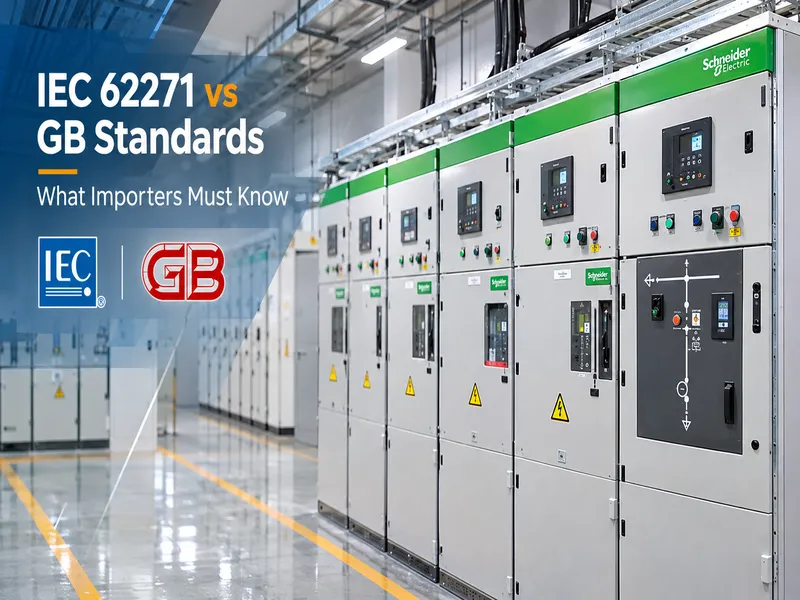 IEC 62271 vs GB Standards for Medium Voltage Switchgear.
2. Which Technical Specifications Require Particular Attention?
Differences between IEC and GB standards must be checked against the actual equipment ratings and test results.
Rated Voltage and Insulation Level
The rated voltage alone is not sufficient to confirm that a switchgear panel is suitable for a particular electrical system.
Importers must also verify the rated short-duration power-frequency withstand voltage and rated lightning impulse withstand voltage.
For example, two switchgear panels with a rated voltage of 12 kV may not necessarily meet the same project insulation requirements.
The correct approach is to compare the manufacturer's technical datasheet and type test report with the insulation levels specified in the project documentation.
For installations at high altitudes, additional verification of external insulation performance may also be necessary.
Short-Time Withstand Current and Breaking Capacity
Short-time withstand current and circuit breaker short-circuit breaking capacity are two different ratings.
Consider a switchgear panel specified at 25 kA/1 s.
The main circuit must be capable of withstanding the specified short-circuit current for one second under the applicable test conditions. However, this does not automatically confirm that the installed circuit breaker has the required short-circuit breaking capacity.
The importer should therefore check both the switchgear assembly rating and the circuit breaker's breaking and making capacities.
These values must be consistent with the system short-circuit calculation and project specifications.
Internal Arc Classification
Some international EPC projects specify an internal arc classification of IAC AFLR 25 kA/1 s.
Under IEC 62271-200, this classification indicates that the equipment has been tested for internal arc performance under defined conditions.
The letter A refers to accessibility for authorized personnel, while F, L, and R identify the front, lateral, and rear sides covered by the classification.
A short-time withstand current test does not replace an internal arc test.
If the manufacturer only provides a short-circuit withstand test report, the importer cannot assume that the switchgear meets the specified IAC classification.
The tested pressure relief arrangement, enclosure construction, and installation conditions should also be checked against the actual supplied configuration.
Environmental Conditions
Environmental requirements can affect switchgear selection as much as electrical ratings.
For projects in the Middle East, high ambient temperatures may affect the equipment's continuous current-carrying capacity.
For coastal installations, corrosion protection, condensation control, and the suitability of insulating materials require particular attention.
If the installation conditions fall outside the equipment's specified normal service conditions, the manufacturer should confirm whether design modifications or rating adjustments are necessary.
Standard catalogue ratings should not be used without checking their applicable service conditions.
3. Can Chinese GB Type Test Reports Be Accepted for Overseas Projects?
A GB/T type test report can provide useful technical evidence, but whether it is accepted depends on the project specifications and approval requirements.
The first step is to check the standard edition stated in the report.
The second is to confirm that the tested equipment configuration covers the switchgear being supplied.
For example, a manufacturer may provide a type test report for a 12 kV, 1250 A, 25 kA switchgear panel.
If the actual equipment uses a different enclosure design, switching device, or busbar arrangement, the importer must verify whether the original report remains applicable.
When the specified IEC edition differs from the GB/T standard used for testing, the following documents may be requested:
- Type test reports covering the applicable IEC standards
- IEC and GB/T standards comparison or deviation statement
- Additional test results or supporting technical documentation, where required
- Technical datasheets and general arrangement drawings for the supplied models
- Factory routine test records and agreed Factory Acceptance Test (FAT) documentation
A complete new type test programme is not necessarily required for every switchgear product exported from China.
The need for additional testing depends on the differences between the standards, modifications to the equipment design, and the project owner's acceptance criteria.
4. How Do Import Requirements Differ Across Markets?
European Union
European medium-voltage switchgear projects commonly reference the EN 62271 series.
Importers should verify the applicable EN standards and determine which EU regulatory requirements apply to the equipment.
An IEC type test report does not, by itself, establish compliance with every applicable EU market requirement.
The need for CE marking and related conformity documentation must be assessed under the regulations that apply to the specific product.
Middle East
Many utility and industrial projects in the UAE, Saudi Arabia, and other Middle Eastern markets use IEC standards.
However, local utilities and project owners may impose additional requirements covering manufacturer approval, equipment ratings, environmental performance, and technical documentation.
A switchgear panel with a valid IEC type test report is not automatically approved for every local utility project.
Importers should confirm the applicable utility specifications and manufacturer approval requirements before placing an order.
Southeast Asia and Australia
Projects in Southeast Asia and Australia may specify IEC standards, AS/NZS standards, or additional requirements issued by local utilities.
The main points to verify include insulation levels, short-circuit ratings, internal arc classification, and installation conditions.
Importers should work from the project's actual technical specifications rather than assuming that compliance with a general IEC standard satisfies all local requirements.
China
For switchgear imported into mainland China, the equipment must meet the applicable Chinese standards and project specifications.
Whether China Compulsory Certification (CCC) is required depends on the product category and the current compulsory certification catalogue.
Not every medium-voltage switchgear product is subject to CCC certification.
Technical compliance and customs clearance should also be treated as separate matters.
Importers must independently verify the correct customs classification, declaration documents, and any applicable import restrictions or regulatory requirements.
5. What Documents Should Importers Check Before Ordering Switchgear?
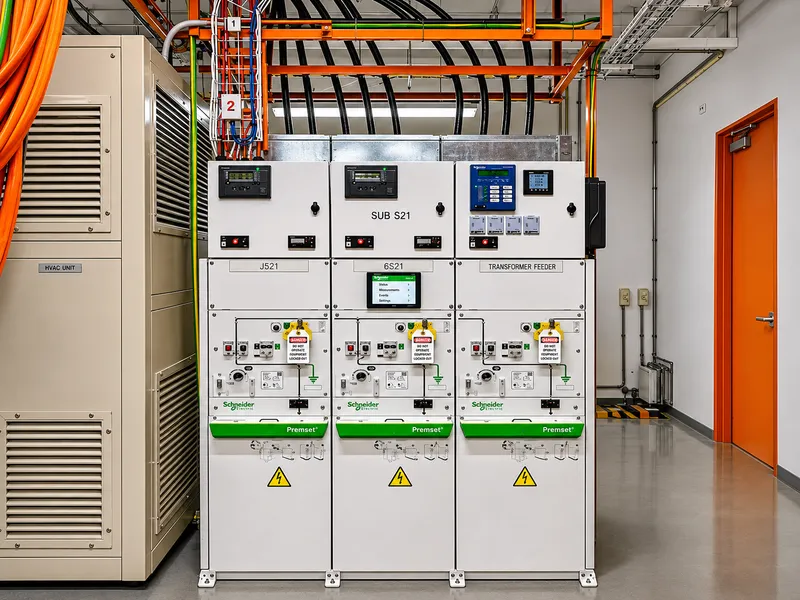
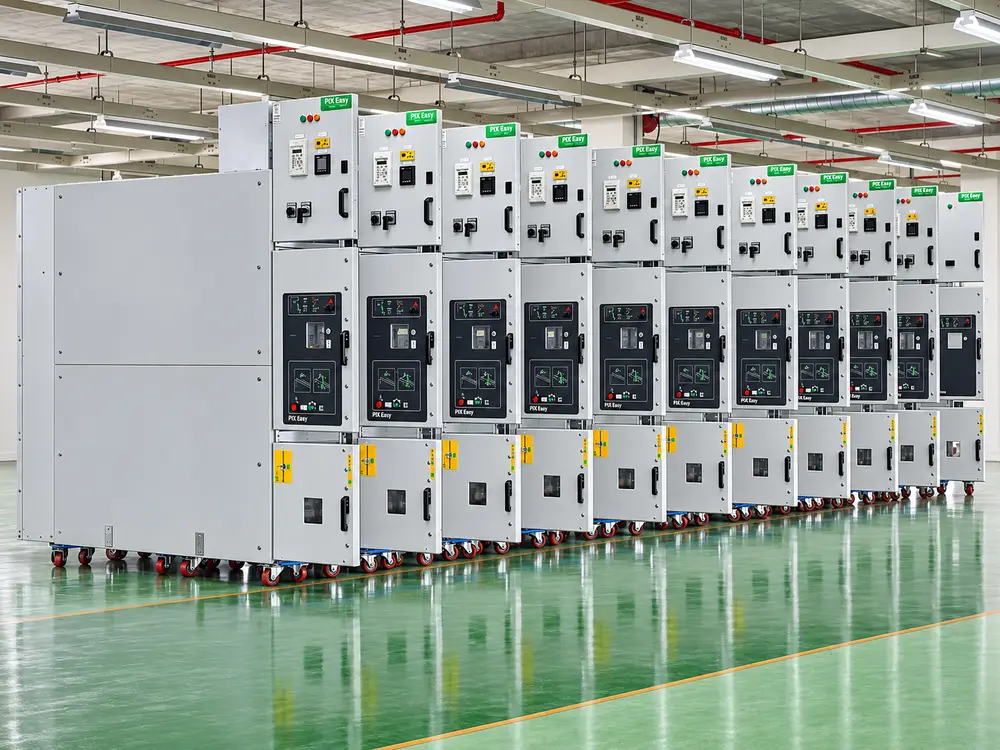
Whether purchasing Schneider Electric PIX, SM AirSeT, RM AirSeT, or medium-voltage switchgear from other manufacturers in China, the documentation should be reviewed against the actual models and configurations being supplied.
The following six checks should be completed before confirming an order.
1. Applicable Standards
Confirm whether the project requires IEC 62271, Chinese GB/T standards, or another national standard. The exact edition should be stated in the technical specifications.
2. Electrical Ratings
Check rated voltage, rated current, insulation levels, short-circuit ratings, and internal arc classification against the project requirements.
3. Type Test Reports
Verify the manufacturer, tested model, test standard, testing laboratory, and equipment configuration covered by each report.
4. Supplied Equipment Configuration
Confirm that the circuit breaker, busbar system, current and voltage transformers (CTs/VTs), protection relays, and control circuits match the approved technical drawings.
5. Local Approval Requirements
Check whether the destination market or project owner requires manufacturer prequalification, additional certification, or specific technical approval documents.
6. Shipping and Handover Documents
Before shipment, review the equipment nameplates, packing list, origin documentation, factory test records, and other documents specified in the purchase contract.
One issue deserves particular attention: the relationship between a type test report and the equipment actually delivered.
Different ratings or enclosure designs within the same product family may not be covered by identical test results.
A report issued for one configuration should not be assumed to cover every variation of that switchgear series.
Importers should verify the scope of the available test evidence rather than simply asking whether the manufacturer has an "IEC certificate."
Conclusion
IEC 62271 and Chinese GB/T standards share many technical principles, but differences in standard editions, equipment scope, and testing requirements must be reviewed before they are treated as equivalent.
For medium-voltage switchgear imports, three questions should be answered before signing the purchase contract:
- Which standard and edition does the project require?
- Which equipment configurations are covered by the manufacturer's type test reports?
- Does the actual supplied switchgear meet the destination market's technical and approval requirements?
Checking these points during procurement helps identify technical deviations before manufacturing and shipment, reducing the risk of additional testing, equipment modifications, and delays during project acceptance.